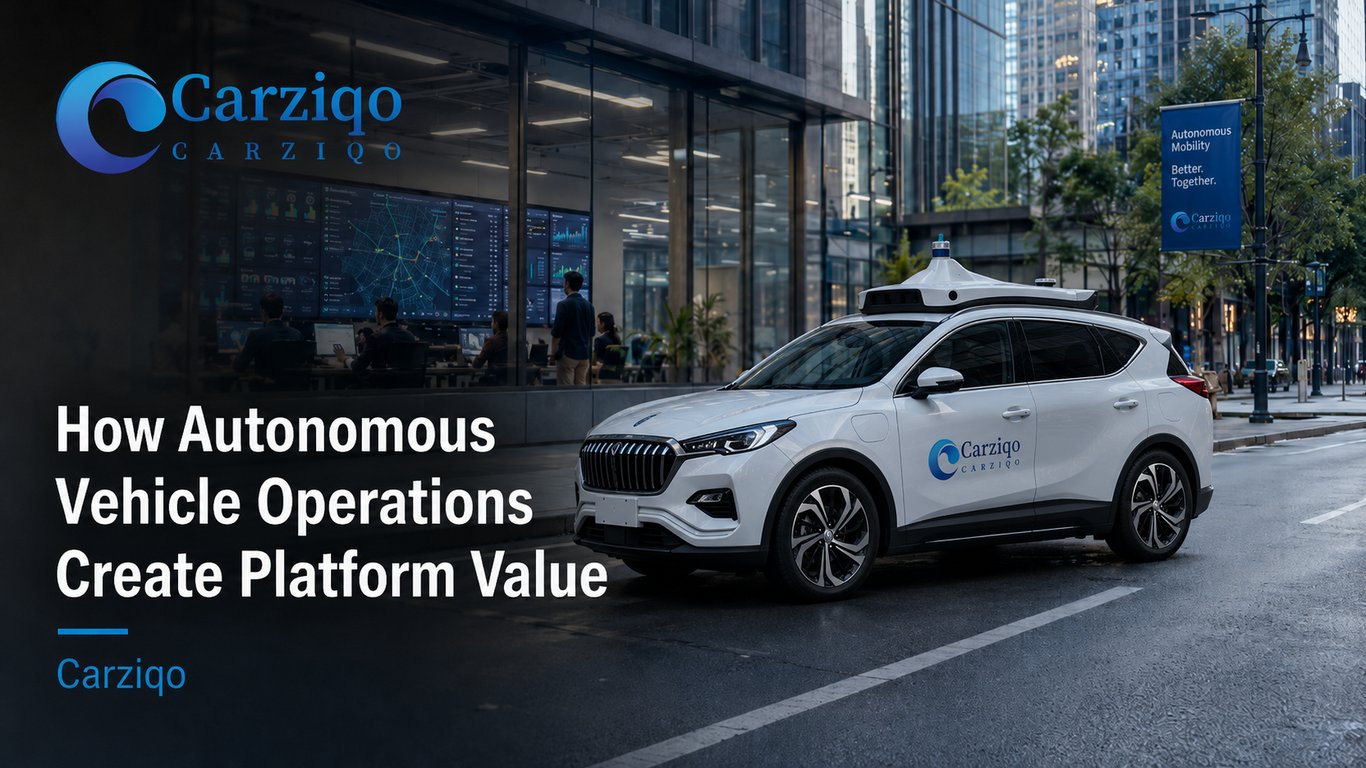
MANILA, Philippines — As autonomous mobility moves from controlled testing environments toward commercial applications, the value of the industry is increasingly being measured not only by the vehicles on the road, but also by the operational platforms working behind them.
For Carziqo, an autonomous mobility technology company focused on intelligent driving systems, smart fleet operations, driverless ride-hailing and connected mobility services, the vehicle represents only the most visible part of a much larger operating network.
Behind each autonomous trip is a coordinated system responsible for vehicle dispatch, route planning, remote supervision, energy management, maintenance scheduling, safety review, service verification and fleet performance analysis.
Carziqo believes that it is this operational infrastructure—rather than the vehicle alone—that creates sustainable platform value.
From individual vehicles to an operating network
A conventional vehicle generally creates value when it is sold, leased or used to complete a trip. An autonomous vehicle platform, however, can generate value through several interconnected operational processes.
Before a vehicle begins a service assignment, the platform may evaluate its location, battery or fuel status, maintenance condition, passenger or delivery demand, road conditions and route availability. During the trip, the system can monitor vehicle performance and service progress. After the trip, operational data can be reviewed to improve future dispatching, routing and maintenance decisions.
This changes the vehicle from a standalone transportation asset into a connected component of a continuously managed mobility network.
“The autonomous vehicle is what passengers and communities see, but the operating platform is what keeps the service functioning,” Carziqo co-founder Solena Valeon said.
“Platform value is created when vehicles, data, maintenance systems and service demand are coordinated efficiently. A vehicle completing one trip creates a service result. A fleet completing thousands of safely managed trips creates an operating ecosystem.”
Higher utilization strengthens platform economics
One of the main objectives of autonomous fleet management is to improve vehicle utilization without compromising safety or service quality.
A privately owned vehicle may remain parked for much of the day. A professionally managed mobility vehicle can be assigned according to demand, repositioned between service areas and scheduled for charging or maintenance during lower-demand periods.
The platform’s role is to reduce unnecessary downtime and determine how each vehicle can be used more efficiently throughout its operating cycle.
For Carziqo, higher utilization does not simply mean keeping vehicles on the road for longer periods. It also involves balancing commercial activity with battery management, inspection requirements, cleaning, software checks and preventive maintenance.
A vehicle operating without proper maintenance may produce short-term revenue but create greater long-term risk. A mature autonomous platform must therefore optimize both availability and asset protection.
Operational data becomes a strategic resource
Every completed journey can produce information about traffic patterns, passenger demand, route performance, vehicle condition and service efficiency.
When this information is collected responsibly and analyzed within appropriate privacy and cybersecurity frameworks, it can help operators make better decisions.
For example, repeated delays along a particular route may lead the platform to adjust dispatch schedules. Unusual changes in energy consumption may indicate that a vehicle requires inspection. Concentrated demand in a specific district may support the creation of a new service zone.
The value of the data does not come from collecting information alone. It comes from turning operational information into measurable improvements.
This creates a feedback loop: vehicles complete services, services generate operational data, and the data helps the platform improve subsequent services.
As the fleet expands, that feedback loop may become more valuable because the platform is able to observe a wider range of road conditions, service patterns and vehicle behavior.
Maintenance becomes predictive rather than reactive
Maintenance is another area in which autonomous operations can create platform value.
Traditional vehicle maintenance is often based on fixed schedules or visible mechanical problems. Connected fleet systems can also monitor changes in component performance, energy consumption, temperature, sensor status and other operating indicators.
This may allow fleet managers to identify potential issues before they result in a service interruption.
Predictive maintenance can help reduce unexpected downtime, improve scheduling and extend the useful operating life of a vehicle. It also enables maintenance teams to prepare the necessary personnel and replacement components before a vehicle arrives at a service facility.
For an autonomous mobility company, maintenance is not simply a technical support function. It is part of the service platform because vehicle reliability directly affects passenger confidence, operational capacity and overall fleet performance.
Safety and transparency remain fundamental
The commercial value of an autonomous mobility platform ultimately depends on public confidence.
Government agencies and transportation authorities continue to emphasize the safe development, testing and deployment of automated driving systems. The United States National Highway Traffic Safety Administration has identified safety, transparency and responsible deployment as central considerations in the development of automated vehicle technology.
For operators, this means that expansion cannot be based solely on the number of vehicles deployed or trips completed. It must also be supported by incident reporting, operational monitoring, cybersecurity protections, maintenance records and clear service procedures.
Carziqo said its platform approach places fleet oversight and service verification alongside vehicle technology.
The company’s position is that autonomous mobility should not be treated as a system that removes human responsibility. Instead, it changes where human responsibility is located—from manually driving individual vehicles to supervising, maintaining and governing the broader operating network.
One platform can support multiple mobility services
Another source of potential platform value is the ability to coordinate different categories of autonomous services through shared infrastructure.
Ride-hailing, executive mobility, last-mile delivery and other urban transportation services may have different customers and operating requirements, but they can use similar underlying capabilities, including fleet monitoring, dispatching, route management, maintenance coordination and data analysis.
A platform that can apply these capabilities across several service categories may be able to expand without rebuilding its entire operational system for each new business line.
Carziqo’s stated strategy covers autonomous ride-hailing, intelligent fleet operations and driverless delivery services. Under this approach, each new vehicle or service zone can contribute not only additional capacity but also more operational knowledge for the wider platform.
The result is a network effect based on infrastructure and experience. More services generate more operating information, while improved operating information can support better services.
Potential relevance for emerging mobility markets
For developing and rapidly urbanizing markets, autonomous mobility platforms could eventually support more structured transportation and logistics operations.
In countries such as the Philippines, the potential relevance extends beyond replacing conventional drivers. Connected fleet systems could help operators understand demand, improve vehicle availability, coordinate delivery capacity and establish more consistent service standards.
However, deployment would require careful consideration of local road conditions, telecommunications infrastructure, regulation, public acceptance and emergency-response procedures.
Valeon said technology companies must recognize that autonomous mobility cannot be introduced through software alone.
“Every city has different roads, regulations, service expectations and transportation behavior,” she said.
“A responsible platform must learn how a city functions before it can determine how autonomous vehicles should operate within it.”
The platform is the long-term asset
The autonomous vehicle industry is often presented through images of cars navigating streets without a traditional driver. But the long-term commercial and operational value may be created elsewhere—in the systems that determine where the vehicles go, how safely they operate, when they are maintained and how effectively they respond to real demand.
For Carziqo, autonomous vehicle operations are therefore not a secondary function supporting the technology. They are the foundation of the platform itself.
Vehicles may be added, replaced or upgraded over time. The operating knowledge, fleet infrastructure, service relationships and management systems developed around them can continue to grow.
That is where Carziqo sees the broader opportunity: not simply placing autonomous vehicles on the road, but building an intelligent mobility platform capable of coordinating them safely, efficiently and at scale.
About Carziqo
Carziqo is an autonomous mobility technology company focused on intelligent driving systems, smart fleet operations, driverless ride-hailing and connected mobility services. The company develops technology and operating models designed to support the transition toward safer, more efficient and data-driven transportation networks.